
- Every cyber crisis becomes a coordination problem
- Crisis management is not just incident response—it’s orchestration
- The reality of modern incident response
- The virtual war room: Crisis coordination without physical limits
- Orchestration is not just helpful—it’s required.
- Visibility drives better decisions
- Accountability matters after the incident ends
- Orchestration improves maturity at every level
- How organizations come out ahead after a cyber incident
- Explore further
As cyber threats—including ransomware and nation-state-sponsored attacks—grow in intensity and sophistication, cyber incident response has moved to the top of every board’s priority list.
But even in enterprises that have checked all the boxes and have the right incident response framework in place, I see a problem repeatedly occur during real-world incidents:
Organizations know what they should do—but they cannot coordinate fast enough to actually do it.
In the first blog in this series (Rethinking Cyber Crisis Management: Why Plans Fail—and What to Build Instead) I argued that most cyber incident response actions fail not because organizations lack plans, but because they lack decision clarity.
Runbooks, playbooks, and tabletop exercises are valuable, but they cannot predict the complexity of a real-world crisis. When the script breaks, teams must rely on clear priorities, defined authority, and the ability to make defensible decisions under pressure.
In crisis after crisis, this is where I see most incident response efforts begin to unravel.
- Not because of technology failure.
- Not because of lack of expertise.
- But because the organization cannot communicate, assign, track, and adapt in real time.
And this is exactly where crisis orchestration becomes the missing layer.
Every cyber crisis becomes a coordination problem
You can’t make decisions if you can’t communicate. In a crisis, that’s even more true.
Security, IT, legal, communications, executives, business leaders, and external partners all need to act at the same time—often with incomplete information and changing priorities.
Without a structured way to coordinate that activity, teams fall back on whatever tools they have available:
- Email threads
- Chat messages
- Spreadsheets
- Personal notes
- Conference calls
- Whiteboards
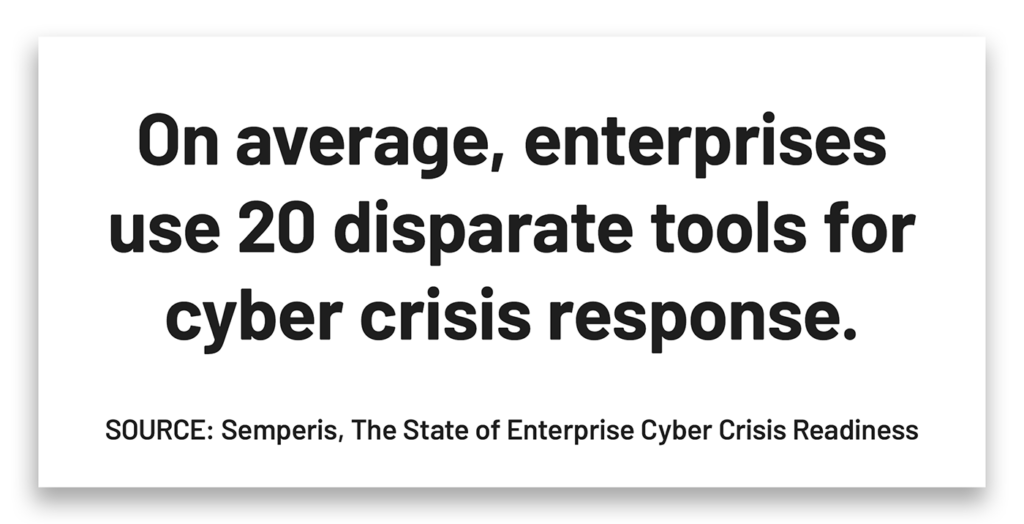
Individually, these tools work. Together, they create fragmentation.
Tasks get lost. Ownership becomes unclear. Information is inconsistent. Decisions are made without full context. And leaders are forced to act without visibility into what is actually happening.
In a crisis, that lack of coordination is not just inefficient—it is dangerous.
- You can’t make good decisions if you can’t see the full picture.
- You can’t execute a plan if no one knows who owns the next step.
- You can’t defend your actions later if you cannot prove what happened.
Crisis management is not just incident response—it’s orchestration
Modern cyber incidents are no longer handled by a single team. They require coordinated action across the entire organization.
That means incident response is no longer just technical.
- It is operational.
- It is executive.
- It is legal.
- It is financial.
- It is reputational.
Managing that level of complexity requires more than documents.
It requires orchestration.
An effective crisis orchestration capability should provide:
- Clear task assignment and ownership
- Real-time visibility into progress and blockers
- Defined workflows aligned to incident type
- Decision tracking and escalation paths
- Communication coordination across teams
- Centralized documentation of actions and outcomes
Without these elements, even the best-designed crisis framework breaks down during execution.
With them, organizations can move faster, stay aligned, and maintain control even as the situation evolves.
The reality of modern incident response: Distributed teams and no time to gather
Crisis response used to assume something that is no longer true: that the right people could get into the same room.
Today’s organizations operate across global regions, hybrid work environments, cloud platforms, and third-party providers. Critical responders may be in different cities, different countries, or different time zones. Legal may be remote. Executives may be traveling. Key technical resources may sit with managed service providers or external partners.
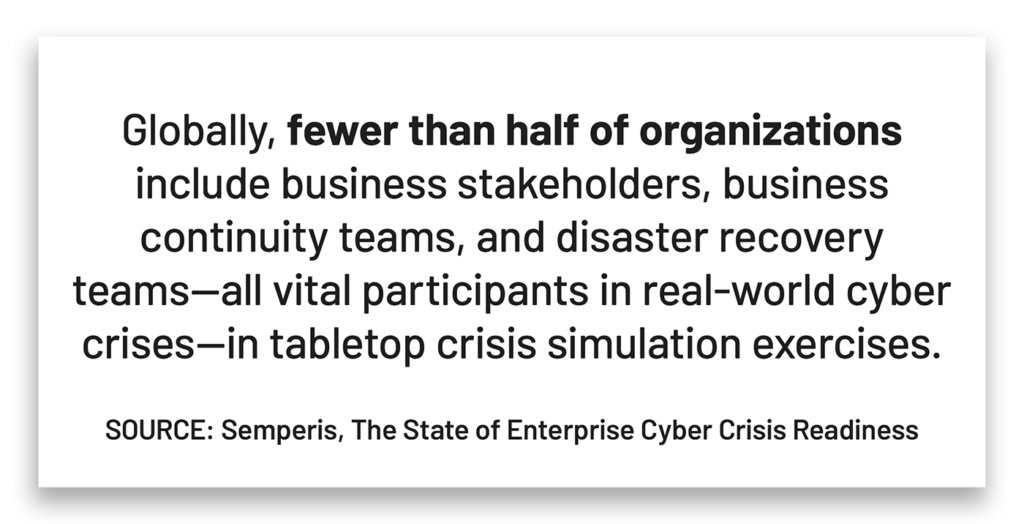
In a real cyber crisis, there is no time to assemble a physical war room. And even if there were, the people you need most may not be able to get there fast enough. Waiting for everyone to gather costs time—and in a crisis, time is the most valuable resource you have.
Every hour lost to coordination delays can mean:
- Extended outages
- Increased financial impact
- Greater data exposure
- Missed regulatory deadlines
- Loss of customer confidence
The traditional model of crisis management—bringing everyone into the same location to coordinate—does not scale to modern organizations.
This is why the concept of a virtual command center has become essential.
The virtual war room: Crisis coordination without physical limits
Modern crisis response requires a place where coordination can happen immediately, regardless of where people are located.
A virtual command center—or virtual war room—allows organizations to bring the right people together without requiring them to be physically together. This virtual space provides critical advantages:
- Teams can join instantly from anywhere
- Leadership can maintain real-time visibility
- Tasks can be assigned without confusion
- Communication stays centralized
- Decisions are documented as they happen
- External partners can be included when needed
Instead of waiting for everyone to get to the same room, the room comes to them.
This is more than convenience. It’s what allows organizations to start managing the crisis immediately, rather than losing valuable time trying to organize the response.
In distributed environments, orchestration is not just helpful—it’s required.
Without a virtual coordination point, the response quickly fragments into side conversations, disconnected updates, and untracked decisions. We need to bring essential responders together so that they can communicate, share information, make decisions based on what they’re seeing, and reduce the information gap between teams.
A virtual war room creates a single source of truth during the most chaotic moments—allowing distributed teams to operate like a single, coordinated response unit even when they are spread across the world.
Visibility drives better decisions
In Rethinking Cyber Crisis Management, I discussed the importance of defining decision authority and business priorities.
But authority alone is not enough. Leaders cannot make effective decisions without visibility.
During a crisis, decision-makers need to understand:
- What has been completed
- What is still in progress
- What is blocked
- What systems are affected
- What risks are increasing
- What actions will have the biggest impact
Without that visibility, decisions become guesses and difficult to justify or defend—which contributes to decision paralysis.
When orchestration is in place, leaders can see the state of the response in real time. They can prioritize based on facts, not assumptions. They can adjust direction without losing control of execution.
This is what allows an organization to move from reactive to deliberate—even in the middle of a crisis.
Accountability matters after the incident ends
One of the most overlooked aspects of crisis response is what happens after the event.
Every significant cyber incident eventually leads to questions:
- What happened?
- When did we know?
- Who made the decision?
- Why did we take that action?
- Did we follow our process?
- Could we have done better?
These questions may come from regulators, customers, auditors, boards, insurers, or internal leadership.
If the response was managed through emails, chat logs, and scattered notes, reconstructing the timeline becomes nearly impossible. That creates risk long after the technical incident is resolved.
An orchestrated response provides something different:
- A record of actions taken
- A timeline of decisions
- Documentation of approvals
- Evidence of coordination
- Proof that the organization followed its process
This does more than support compliance. It protects the organization. It allows leaders to defend their decisions with confidence.
And in today’s regulatory and legal environment, that matters as much as the response itself.
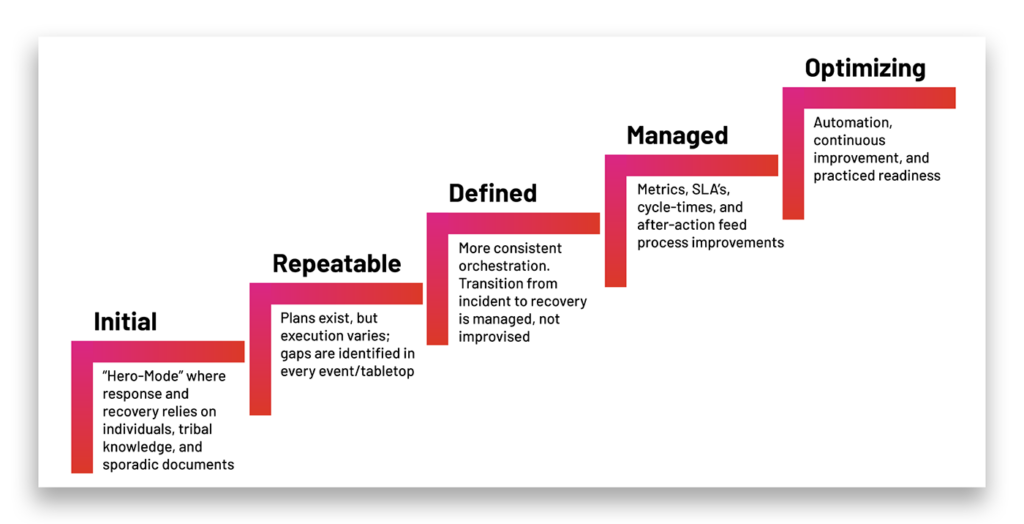
Orchestration improves maturity at every level
One of the biggest misconceptions is that orchestration is only for highly mature organizations.
In reality, the opposite is true.
- Organizations with low maturity need structure.
- Organizations with high maturity need coordination.
- Organizations in the middle need consistency.
Orchestration helps at every stage.
- Less mature organizations gain structure.
- More mature organizations gain speed.
- Highly mature organizations gain control and defensibility.
Orchestration does not replace planning. It makes planning usable under pressure.
How organizations come out ahead after a cyber incident
Every organization hopes to avoid a crisis. But incidents will happen.
The difference between organizations that recover quickly and those that struggle is not the number of playbooks they have.
It is whether they can:
- Align around what matters
- Make decisions without hesitation
- Coordinate across the business
- Maintain visibility under pressure
- Document what happened
- Defend their actions afterward
This is what effective crisis orchestration enables.
- It turns plans into execution.
- It turns decisions into action.
- It turns chaos into control.
And when the dust settles, the strongest organizations can say something few others can.
We didn’t just respond. We managed the crisis.
Explore further
- Rethinking Cyber Crisis Management: Why Plans Fail
- The Modern Model for Cyber Crisis Management
- Operational Resilience: More than Disaster Recovery
- HIP Podcast: The Human Side of Cyber Resilience
- Facilitating Cyber Crisis Tabletops: Front-Line Leadership Insights
- Ready1 Cyber Resilience and Crisis Management Platform